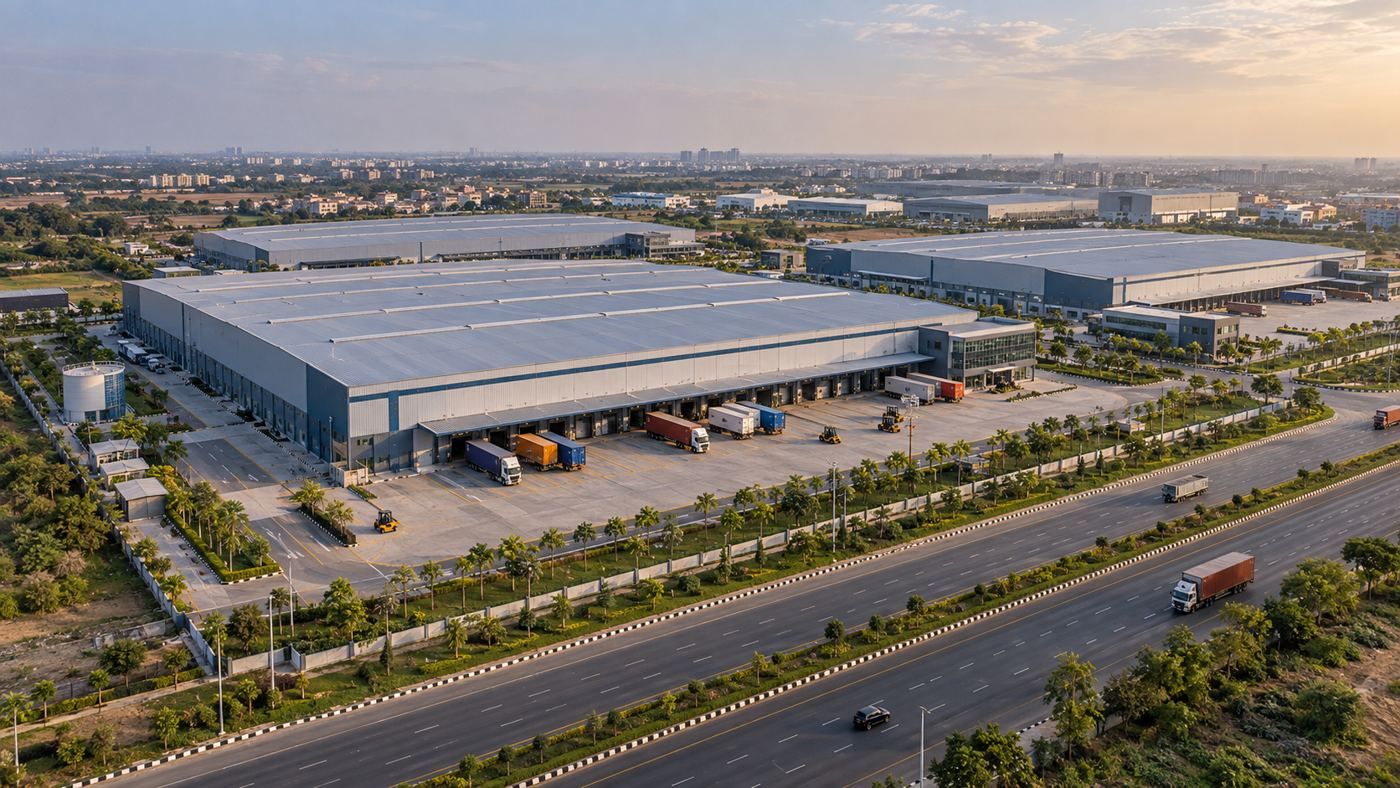
Brookfield has entered India’s industrial and logistics real estate market by acquiring a 100% interest in a portfolio developed and managed by ESR India. The global investment firm has committed ₹4,300 crore, or about $450 million, toward the transaction and future development of the assets, according to reports published on 7 October 2026.
The distinction is important: the disclosed ₹4,300 crore is not described solely as the purchase price for the existing properties. It covers both the acquisition and planned future development. No separate public breakdown between those two uses was available in the sources reviewed.
The portfolio spans 10.5 million square feet across more than 400 acres and six metro clusters. It includes eight Grade A industrial and logistics parks serving gateway markets that include Mumbai, Pune, Delhi-NCR, Chennai and Kolkata. ESR will continue managing the properties in the near term, providing operating continuity after the change in ownership.
Brookfield gains immediate scale in Indian warehousing
The operating portfolio is approximately 98% leased and serves a mix of logistics and industrial occupiers. Its facilities include warehouses, fulfilment centres and light-manufacturing space located near established freight, manufacturing and consumption corridors.
For Brookfield, the deal adds an industrial and logistics platform to an Indian real-estate presence already concentrated in offices and hospitality. The Economic Times described the transaction as Brookfield’s first move into India’s logistics realty market, while Business Standard reported that the investor has more than $13 billion of real-estate assets in India and approximately $33 billion of assets under management in the country across several investment categories.
Those wider figures provide context for the buyer’s scale, but they should not be added to the ₹4,300 crore commitment or treated as money allocated to this logistics portfolio.
The transaction also extends an existing relationship between Brookfield and ESR in the Asia-Pacific region. Brookfield takes ownership of the portfolio, while ESR’s near-term management role means customers are not necessarily dealing with an immediate replacement of the operating platform.
What the portfolio includes—and what remains undisclosed
The announcement establishes the portfolio’s total area, broad geography, park count and reported occupancy. It does not publicly allocate the 10.5 million square feet among each named city in the material reviewed, nor does it disclose individual tenant contracts, property-level rents or lease-expiry schedules.
Similarly, a reported 98% leased level should not be read as 98% physical utilisation on every day or at every property. Leasing refers to space under contract; operational use can vary by tenant and site. The figure is nevertheless relevant because it indicates that Brookfield is acquiring a portfolio with substantial existing occupancy rather than only undeveloped land.
The assets are described as Grade A parks, a market term generally associated with modern specifications and institutional-quality facilities. Buyers, tenants and investors still need property-specific information to compare building design, clear heights, floor-load capacity, fire and safety systems, truck circulation, utilities and environmental performance.
Why the Brookfield–ESR deal matters for India’s logistics market
This is a significant institutional transaction because it gives a large global investor immediate exposure across multiple Indian warehousing markets. Rather than building a national platform one site at a time, Brookfield is acquiring an operating portfolio and a development pathway in one transaction.
The deal also reflects institutional demand for modern logistics property supporting manufacturing, retail distribution, e-commerce fulfilment and third-party logistics. ESR’s official India material describes its broader platform as serving sectors including electronics, retail, e-commerce, manufacturing, food and beverages, pharmaceuticals and third-party logistics. That broader tenant profile does not confirm which companies occupy the specific assets included in this transaction.
For industrial occupiers, the ownership change does not by itself establish lower rents, new capacity or different lease terms. The immediate practical questions are whether service standards, expansion options and property-management arrangements change after the acquisition. ESR’s continuing management role may reduce short-term operating disruption, but future terms will depend on individual agreements and development decisions.
What investors and local property markets should watch next
The next evidence to monitor is the allocation of Brookfield’s commitment between acquisition and development, followed by project-level additions to the portfolio. New construction, leasing progress and completion dates will show how much the transaction expands physical capacity beyond the existing 10.5 million square feet.
Local markets may also watch whether the portfolio attracts further manufacturing and distribution demand around its parks. The acquisition alone does not prove that nearby industrial land values or warehouse rents will rise. Those outcomes depend on supply, tenant demand, infrastructure access and competing developments in each corridor.
For real-estate investors, the reported 98% leased position points to an operating income base, but it is not enough to calculate the transaction yield or expected returns. Reliable analysis would require the purchase-price allocation, net operating income, financing structure, lease duration, rental escalations and planned development expenditure—details not provided in the reports reviewed.
The verified conclusion is narrower but substantial: Brookfield has entered Indian industrial and logistics real estate at scale through a 10.5-million-square-foot ESR portfolio, with a ₹4,300 crore commitment spanning acquisition and future development. How much new space follows, and how the assets perform under the new ownership, will require subsequent disclosures.
Sources
- The Economic Times — Brookfield enters India logistics realty market with ₹4,300-crore ESR portfolio deal, published 7 October 2026 at 5:07 PM IST.
- Business Standard — Brookfield to acquire ESR India’s logistics portfolio for ₹4,300 crore, published/last updated 7 October 2026 at 6:40 PM IST.
- Mint — Brookfield enters Indian logistics with 10.5 million sq ft ESR portfolio buyout, published 7 October 2026 at 6:48 PM IST.
- ESR India — Industrial and Logistics Parks in India, official company portfolio page, accessed 7 October 2026.
- Brookfield — Global Real Estate Portfolio, official company overview, accessed 7 October 2026.
Source note: The three news reports describe the same announced transaction and should not be counted as three independent deals. A directly hosted copy of the companies’ joint announcement was not located during preparation; transaction details are therefore attributed to the publications that reported the statement.