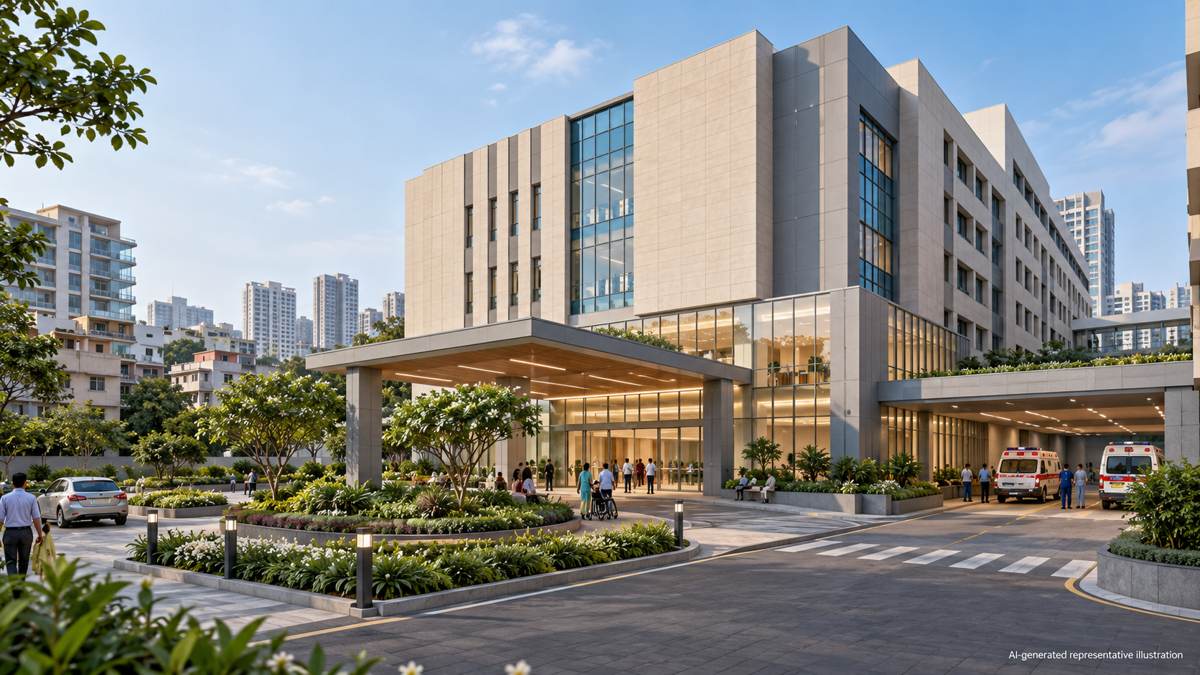
India may require approximately 2.6 billion square feet of additional healthcare real estate by 2035 to reach the global hospital-bed benchmark used in a new CBRE study. The estimate puts specialised property infrastructure in focus alongside conventional offices, retail and housing. CBRE’s report page is dated 15 October 2026; Fortune India published coverage on 16 October at 3:56 PM IST. This is newly covered research, not a construction announcement made tonight. [1,3]
What the healthcare real estate estimate measures
CBRE’s original report links the space requirement to approximately 2.9 million additional hospital beds. Its calculation uses 2021 bed-density ratios of 1.6 per 1,000 people for India and 3.3 globally, population projections and indicative space norms. The report explicitly presents the exercise as illustrative rather than a forecast of actual outcomes. [2]
That distinction changes how the headline should be read. An estimate of infrastructure needed to reach a benchmark does not establish that developers have acquired sites, hospital operators have signed leases or financiers have committed capital. Nor does it identify an annual construction schedule. The number describes a potential gap under stated assumptions, not an order book.
Different locations need different healthcare formats
Fortune India’s account of the study highlights uneven infrastructure across states. It identifies Chhattisgarh, Odisha, Madhya Pradesh and Jharkhand as having relatively low bed availability against disease burden, while Karnataka, Kerala, Tamil Nadu and Telangana have stronger infrastructure and scope for specialised services. The publication also describes interest in outpatient facilities, single-speciality hospitals and buildings accommodating several healthcare providers. [3]
BrickBharat’s assessment is that this makes a uniform national development strategy inappropriate. A large hospital, a neighbourhood diagnostic centre and a cluster of specialist clinics serve different catchments. They cannot be treated as interchangeable square footage simply because all fall within healthcare property.
For a developer, the starting question is therefore who will operate the building and what service it will provide. An attractive site without an appropriate operating partner is not equivalent to a functioning healthcare asset. Similarly, an identified service gap does not by itself demonstrate sufficient paying demand for a particular commercial proposal.
What property owners and investors should examine
The report describes purpose-built leased facilities as one possible expansion model, while warning that transactions involving healthcare businesses do not necessarily include ownership of their underlying properties. [2]
In BrickBharat’s assessment, readers should separate three elements in any subsequent deal: the land and building, the medical operating business, and the contractual relationship between them. A hospital acquisition headline may concern the operating company rather than a property sale. A lease announcement may secure premises without establishing when services will begin.
Useful project-level disclosures would include the operator’s identity, the agreed use, development responsibility, fit-out obligations and commencement conditions. Those details help explain who bears expenditure and delivery risk. A national demand estimate cannot substitute for them, and this report supplies no assured rental yield or return for a particular asset.
What the findings mean for local property markets
For residents comparing neighbourhoods, the practical benefit comes from accessible, operational services—not from a proposed facility appearing in marketing material. A future hospital should therefore be distinguished from one already accepting patients, with its actual services and access independently checked.
For local-market reporting, the next meaningful milestones are identifiable projects, documented funding, construction progress and openings. Until those emerge, it would be premature to translate this national estimate into a claim that nearby residential prices will rise or that a particular city will receive a specified share of investment.
The study broadens the discussion of Indian commercial real estate beyond traditional asset classes. Its immediate value is as a framework for identifying unmet infrastructure needs. Converting that potential into usable space will require project-specific evidence; the scale of the estimate should not obscure the distance between need, investment and delivery.
Sources and verification
- CBRE India — Beyond Core: A 2035 View of India’s Alternate Sectors – Part One. Official report page dated 15 October 2026; no publication time displayed. Confirms the headline estimate and report scope.
- CBRE Research — original report PDF. Cover dated October 2026; linked from the 15 October report page. Printed pages 12–14 explain indicative space requirements, operating models and estimation assumptions. Its underlying bed ratios refer to 2021, updated in the cited source in December 2025; they are not a fresh October 2026 census. The illustrative methodology was inspected, but its external inputs were not independently re-estimated.
- Fortune India — India requires an additional 2.6 billion sq. ft of healthcare real estate by 2035, says report. By P B Jayakumar, published 16 October 2026, 15:56 IST. Used for separately attributed reporting and regional context; it reports the same CBRE research, not an independent second estimate.
Verification scope: The original research and dated coverage were reviewed. No new government allocation, developer commitment, project approval or guaranteed return is asserted. The 15 October release date and 16 October coverage date are deliberately distinguished. Implications labelled as BrickBharat’s assessment are editorial interpretation, not findings measured by the report.