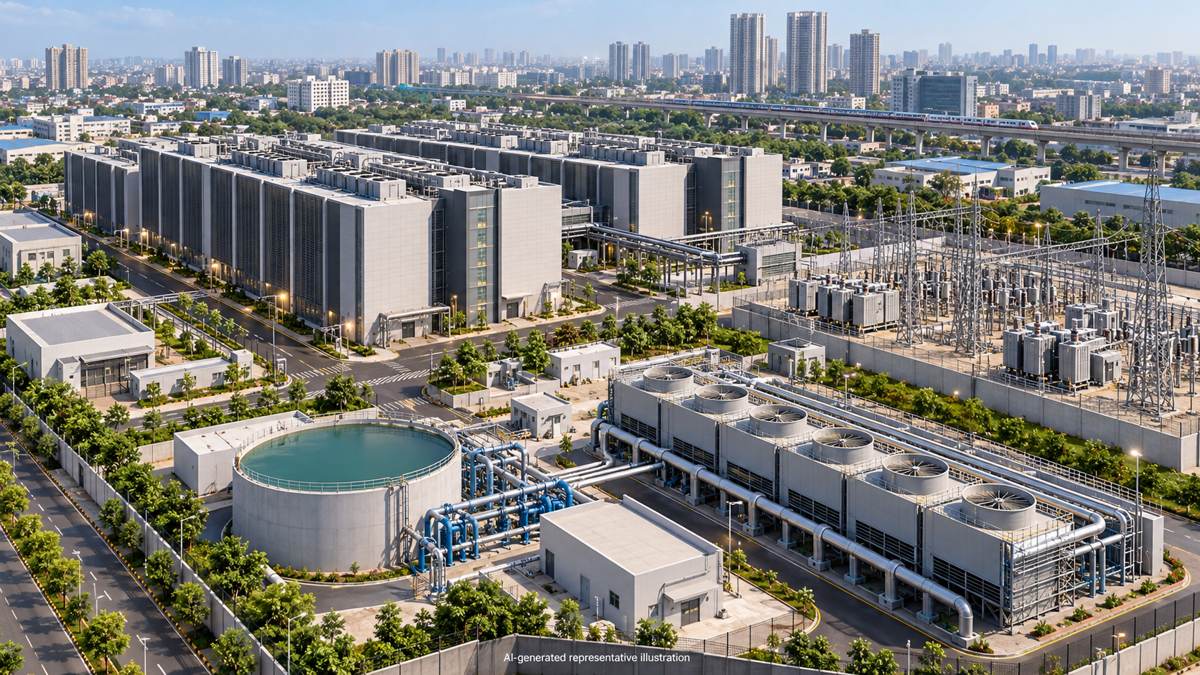
Foreign investors supplied 68% of institutional investment in Indian real estate during the July–September quarter of 2026, while data centres attracted 52% of total capital, according to Cushman & Wakefield’s Q3 India Capital MarketBeat.
The consultancy put total institutional investment at $2.1 billion for the quarter, up 20% year on year and 12% from the preceding quarter. Foreign capital was approximately $1.4 billion, rising 134% annually and 64% sequentially. Domestic investment fell to about $700 million, down 39% year on year and 34% quarter on quarter, Moneycontrol reported on 27 October.
The figures describe tracked institutional transactions under Cushman & Wakefield’s methodology. They are not the value of all property sales in India, and they should not be added to figures from other consultancies without reconciling differences in coverage and definitions.
Data centres became the largest investment segment
Data centres accounted for 52% of Q3 institutional investment, ahead of hospitality at 15% and office assets at 9%. Applying the reported share to the $2.1 billion total indicates roughly $1.09 billion for data centres, but that is a calculated approximation rather than a separately quoted transaction total.
Cushman & Wakefield linked the asset class’s growing importance to demand for cloud computing, artificial-intelligence workloads and data-intensive digital services. Its separate September update placed India’s operational data-centre capacity at 1,789 MW in H1 2026 and estimated that the country could require nearly $29.9 billion of development capital through 2030.
Those long-term estimates concern capacity expansion and required development capital; they are not confirmation that all projects are approved, funded or under construction. Data-centre delivery depends on land, grid connections, power availability, water and cooling design, fibre connectivity and local approvals. Investment interest does not remove those execution constraints.
Foreign capital led the quarter, but domestic investors led nine months
The quarterly shift does not mean domestic institutions withdrew from the market for the year as a whole. Institutional investment totalled $5.5 billion in the first nine months of 2026, 11% more than a year earlier. Domestic capital represented 52% of that nine-month amount, while foreign investors provided 48%.
This difference between quarterly and cumulative figures is important. A 68% foreign share in Q3 marks a sharp return of overseas capital for one quarter, while the January–September data still shows a slight domestic majority. Neither statistic alone establishes the composition of the full calendar year.
Private-equity investors accounted for 88% of Q3 institutional capital and REIT-led transactions for 12%, according to the report summary carried by Moneycontrol. Multi-city transactions represented 76% of activity. Among transactions assigned to a single market, Mumbai drew 9% and Delhi-NCR 6%.
Why investment reports can show different totals
Readers may encounter materially different Q3 figures from other property consultancies. Colliers, for example, reported $1.4 billion of institutional inflows in Q3 and $5.9 billion for January–September. CBRE separately reported a broader $9.5 billion of equity inflows across real estate, data centres and hospitality during Q3.
These numbers are not interchangeable. Research firms can differ in the transaction types, stages, asset classes and capital structures they include. The correct comparison is within one report series unless methodologies have been reconciled. This article uses Cushman & Wakefield’s $2.1 billion measure as its primary dataset and cites other reports only to explain why apparently conflicting headlines can coexist.
What the shift means for property investors and cities
For institutional investors, the quarter shows stronger demand for digital infrastructure and large, scalable opportunities. It does not demonstrate that every data-centre development will achieve the same occupancy, pricing or investment return. Technical reliability, tenant quality, contracted demand, energy cost and time to delivery remain project-specific.
For cities, data-centre capital can support demand for specialised industrial land, power infrastructure, construction and facility operations. The impact on surrounding residential property is less direct. A large facility may be capital-intensive without employing the same number of workers as an office campus, so buyers should not assume automatic housing-price or rental gains nearby.
The verified takeaway is narrower: foreign capital regained the lead in the Q3 institutional-investment mix, and data centres received more than half of the capital recorded by Cushman & Wakefield. The next quarters will show whether that concentration continues or whether office, residential, warehousing and hospitality assets regain a larger share.
Sources and verification
- Cushman & Wakefield — India Capital MarketBeat — official report page dated 15 October 2026; accessed 27 October 2026.
- Moneycontrol — foreign investors and data centres lead Q3 institutional investment — first published 27 October 2026, 2:54 PM IST.
- Cushman & Wakefield — India data-centre H1 2026 update — published 23 September 2026; used for capacity and development-capital context.
- Colliers — India investment overview Q3 2026 — published 7 October 2026; used only to explain scope differences between research series.
Verification note: BrickBharat did not audit transaction-level data. Percentages and totals are attributed to the cited research series; the approximately $1.09 billion data-centre figure is a calculation from the reported share and total.