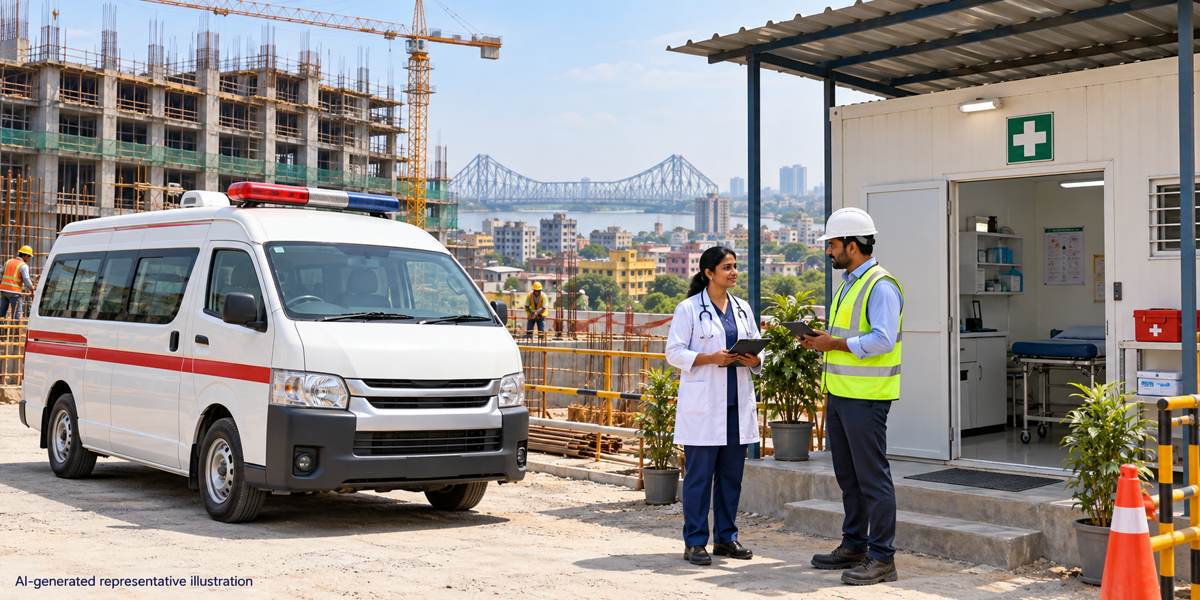
West Bengal's labour department has directed real-estate developers to provide a doctor and an ambulance at construction sites employing 200 or more labourers, according to The Times of India's Kolkata report published shortly after midnight on 16 October. The reported instruction places emergency preparedness within the operational responsibilities of larger building sites. [1]
The publication says the position was communicated at a recent meeting between labour minister Arjun Singh and CREDAI. It does not give the meeting's exact date. Today's publication timestamp should therefore not be presented as the proven date on which a new statutory rule commenced.
What the reported construction-safety direction says
The Times of India reports that the minister warned of surprise visits and action under the law where violations are found. [1] BrickBharat did not retrieve the underlying written direction or notification from the state labour authorities.
That limits what can responsibly be stated about its implementation. The reviewed evidence does not establish an order number, grace period, prescribed doctor attendance hours, ambulance specifications or a fixed penalty for every breach. Those details should not be supplied from assumption.
The official West Bengal Labour Commissionerate website was sought during verification, but it did not yield a dated instrument confirming these particulars. [2] The article consequently reports the department's position through attributed coverage rather than presenting a complete legal compliance checklist.
Why emergency readiness matters to project execution
BrickBharat's assessment is that a medical-response arrangement needs to function as part of site operations, not merely appear in a procurement list. Managers would need to know how assistance is summoned, who coordinates access and whether an emergency vehicle can enter and leave while construction is under way.
These are editorial implementation questions, not additional requirements attributed to the reported direction. A parked vehicle or a room labelled for medical use would not, by itself, allow an observer to evaluate whether an effective response arrangement is available.
Emergency readiness also should not be confused with accident prevention. Protective systems, supervision and a site's approach to hazardous work remain separate questions. The report does not establish that any identified development has passed a comprehensive safety audit.
What developers and contractors should clarify
Before translating a news summary into operating instructions, project teams should obtain the controlling written requirements and confirm which establishment and responsible entity they cover. A project's developer, principal contractor and subcontractors may have different operational roles; this report does not allocate legal liability between them.
The worker threshold also requires precise treatment. The article does not establish whether the count is measured by shift, daily attendance, ordinary employment or another basis. Assuming a definition could produce an incorrect conclusion about whether an individual site falls within the direction.
Existing medical arrangements likewise need to be compared with the applicable instruction. This coverage cannot determine whether a nearby hospital arrangement satisfies a requirement described in the news as an on-site doctor and ambulance.
What homebuyers can—and cannot—infer
For homebuyers, construction-site governance is a useful subject for enquiry, but it is distinct from title, sanctioned plans, project registration and contractual possession. A reported worker-safety direction neither certifies a development for sale nor changes an apartment's delivery date.
Buyers can ask how a promoter documents safety management and contractor oversight without treating an attractive sales-site visit as a technical inspection. This is an editorial evaluation principle, not a finding of non-compliance at any property.
The next material evidence would be publication of the written instruction, clarification of its scope and documented enforcement. Until then, the fresh development is the reported direction and inspection warning—not proof that every qualifying construction site has already deployed the required facilities.
Sources and verification
- The Times of India — doctor and ambulance at large construction sites. Soumitra Nandi; displayed publication 16 October 2026, 00:34 IST. Source for the reported 200-worker threshold, meeting and inspection warning. The meeting's exact date is not stated.
- Government of West Bengal — Labour Commissionerate. Official verification source sought 16 October 2026; page retrieval supplied no usable dated directive. Not cited as independent confirmation of the new instruction.
- Ministry of Labour and Employment — BOCW programme background. Search-indexed official background describes construction-worker safety, health and welfare legislation; direct page retrieval failed. Background only, not proof of the October direction or its current detailed legal operation.
Verification limitation: The original state instrument and enforcement checklist were unavailable. This article is attributed construction-policy reporting, not definitive legal advice or a claim that legislation was amended on 16 October. No clinical advice, casualty estimate or assertion about a named site's compliance is made.