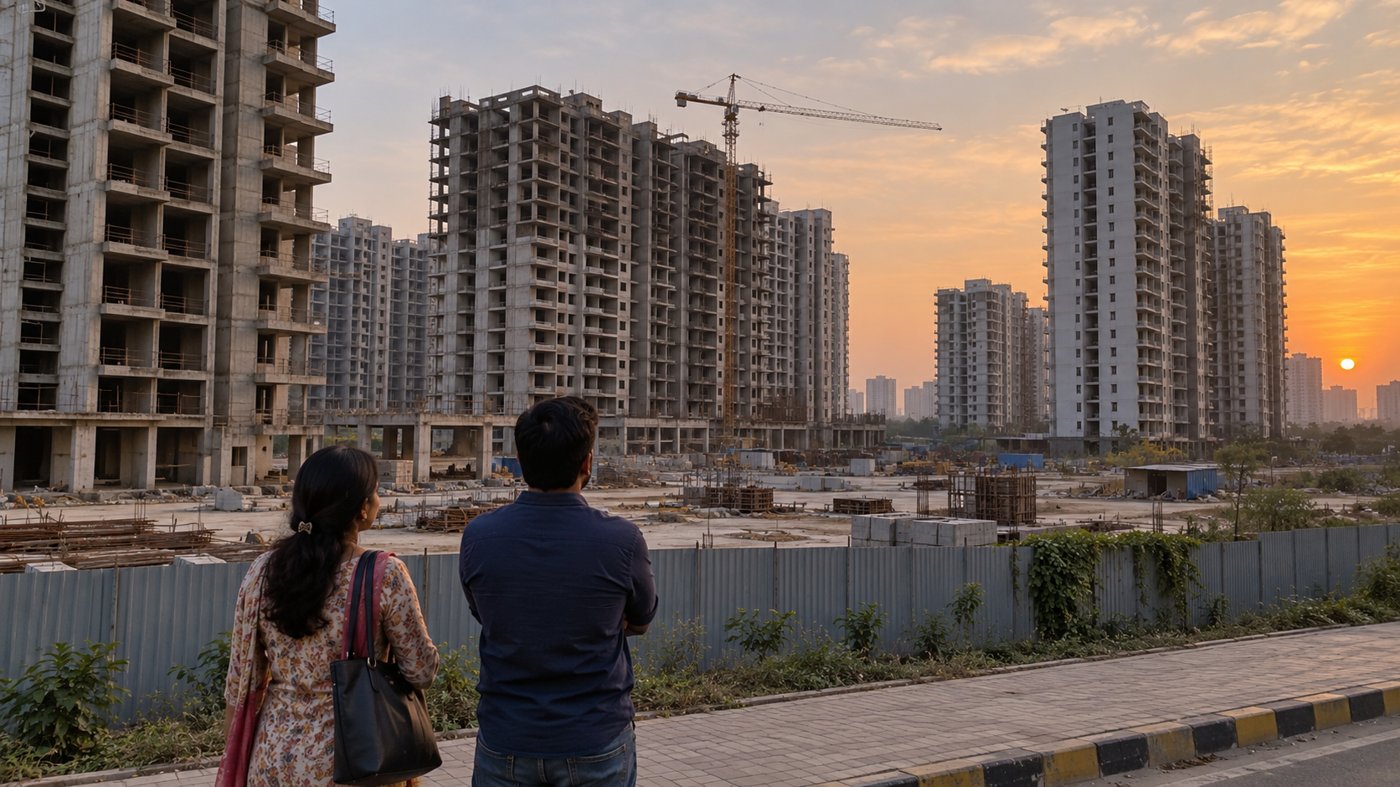
Maharashtra has directed sub-registrars to restrict registration of property documents connected with unauthorised construction, according to reports published on 14 October. The policy is relevant to homebuyers in Mumbai/MMR, Pune and other state markets because the reported checks concern whether the unit being transferred matches the permissions and building plans supporting it. [1,2]
The Times of India identifies a Revenue Department circular dated 12 October 2026 and links it to a meeting held on 22 September. ET Realty's PTI account says officials described the directions on Tuesday, 13 October. Those dates distinguish the reported administrative action and official comments from the following day's coverage. BrickBharat did not retrieve the original circular, so its detailed operative wording remains unverified. [1,2]
Sanctioned flat area becomes a registration issue
The reports agree that a mismatch between the area in the transaction document and the area in the sanctioned plan can trigger refusal of registration. TOI also describes scrutiny where mandatory permissions and supporting papers are absent. Its account covers first-sale agreements, sale deeds, apartment deeds and transfer documents involving units in construction projects. [2]
For a buyer, this means the property description deserves attention before the registration appointment. A brochure's area figure, an agreement's description and a sanctioned drawing may use different terminology. BrickBharat's assessment is that the useful check is a documented reconciliation of the same unit, rather than an informal assurance that a difference is normal.
The reports do not provide a method for resolving every measurement dispute. This article therefore does not calculate a permissible discrepancy or imply that any particular unit will be accepted or rejected.
Reports differ on the certificate checklist
ET Realty describes developers of projects requiring MahaRERA registration as needing the registration certificate, occupancy certificate and sanctioned plan. TOI instead says the MahaRERA certificate “or” occupancy certificate accompanies the sanctioned plan. [1,2]
That difference is material. BrickBharat cannot safely turn the secondary summaries into a universal instruction that every first sale requires an occupancy certificate, nor resolve the alternative-document wording without the controlling text.
The distinction between projects requiring RERA registration and exempt projects is also important. Exemption from one registration requirement should not be assumed to mean exemption from building permissions or every document check. The reported directions describe a separate supporting-document route for exempt projects; buyers should obtain the applicable checklist from the registration authority rather than infer it from a headline.
What Mumbai and Pune homebuyers should verify
Before paying or presenting documents, a buyer can ask the seller to identify the exact sanctioned unit, the permission relied upon and any outstanding discrepancy. Where there is uncertainty, an independent property lawyer or qualified technical professional can help determine which questions need an authority's written response.
These are editorial precautions, not a substitute for legal advice. A refusal to register, a planning violation and a dispute over ownership are different issues. Conversely, successful registration should not be treated as a blanket technical certification of a building.
The announcement does not establish that every older building is unauthorised or that every transaction in an older property is prohibited. Applying such a conclusion across Mumbai's existing housing stock would go beyond the evidence reviewed.
Regularisation is not an automatic remedy
ET Realty reports that buildings violating applicable planning rules must first be regularised, with demolition proceedings contemplated where regularisation is unavailable. [1] The account does not establish eligibility for a specific building, a completion deadline or a guaranteed route to cure deficiencies.
For households, the practical implication is to establish the property's actual status rather than rely on a promise that permission can be obtained later. For the market, the effectiveness of the reported policy will depend on consistent scrutiny and clear instructions.
The next useful evidence is the original circular, any clarifications and documented implementation. Until then, the central verified development is a reported tightening of registration checks—not a transaction-specific legal determination.
Sources and verification
1. ET Realty / PTI — Maharashtra bars registration related to unauthorised constructions. Published 14 October 2026, 08:42 AM IST. 2. The Times of India — Maharashtra bars document registrations for illegal buildings. Displayed date 14 October 2026, 15:48 IST. 3. Maharashtra Registration and Stamps Department. Official source sought 15 October 2026; retrieval failed. No circular number, original wording, commencement provision or exception is claimed as independently checked.
Verification limitation: This is an attributed policy-news report, not definitive legal guidance. The conflicting certificate wording is deliberately preserved as an unresolved issue.