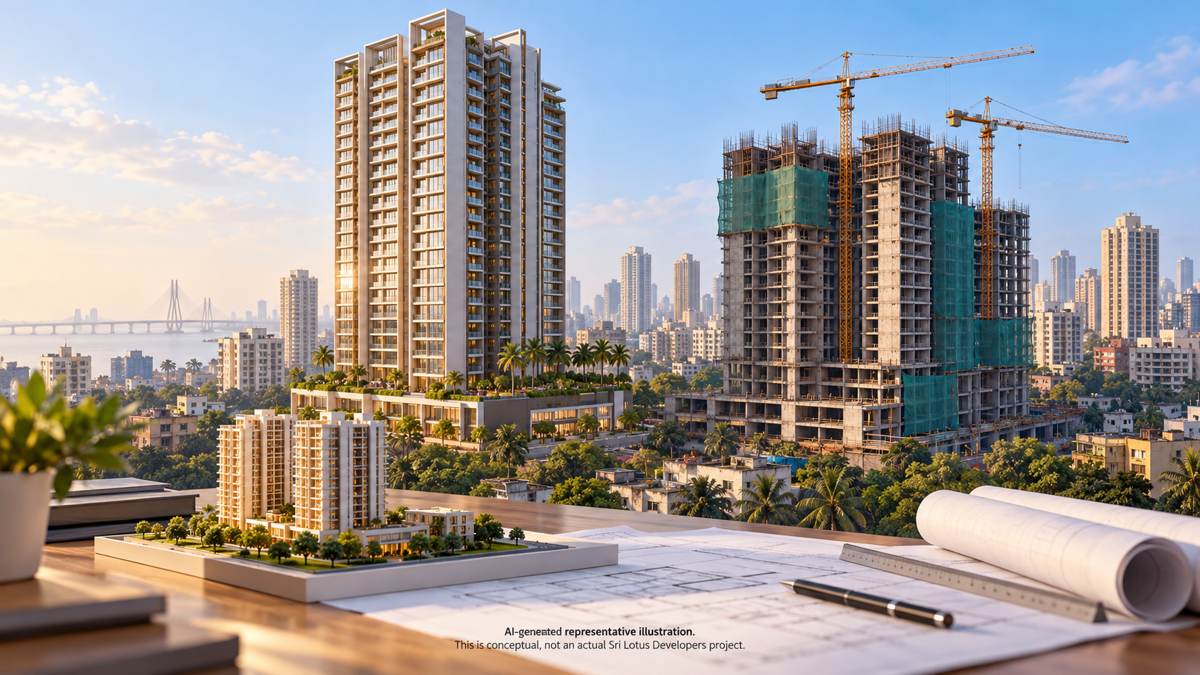
Sri Lotus Developers and Realty reported Q2 FY27 pre-sales of ₹470 crore, up 83% from ₹257 crore a year earlier, in an exchange-hosted investor release dated 15 October. First-half bookings reached ₹879 crore, compared with ₹319 crore a year earlier. The reporting period ended on 30 September; the announcement followed on 15 October. [1]
The Mumbai developer focuses on luxury housing, commercial property and redevelopment. Its quarterly booking growth is a company-level result, not evidence that all Mumbai housing segments expanded at the same rate. Nor does it establish the resale value of apartments in any particular neighbourhood.
Mumbai redevelopment additions expand the pipeline
The release identifies three preferred-developer appointments—Lotus Supremus in Juhu, Lotus Empressa at Shivaji Park in Dadar West, and Lotus Stellar in Versova—plus additional area at Lotus Insignia. Together, management estimates ₹2,700–2,800 crore of gross development value, or GDV. [1]
A preferred-developer appointment should not be treated as proof that every subsequent project milestone is complete. For readers considering redevelopment opportunities, the useful distinction is between securing a development opportunity and producing housing that can be offered under a fully documented project plan.
The estimate also measures potential development value rather than the amount of cash spent acquiring land or constructing buildings. It cannot be added to quarterly bookings and described as current revenue. The stages may relate to the same underlying development over different periods.
Planned launches are not completed sales
Sri Lotus plans four second-half FY27 launches with estimated combined GDV of ₹3,500–4,000 crore. Its full-year pre-sales guidance is ₹1,800–2,000 crore. Both are management expectations, not completed outcomes. [1]
BrickBharat calculates that, after first-half bookings, another ₹921–1,121 crore would be needed to reach that annual range. This arithmetic is not a forecast: it simply describes the distance between the reported first-half result and the stated objective.
Whether the gap is closed will depend on what reaches the market, the inventory actually offered and subsequent customer decisions. A launch calendar can indicate the intended timing of business activity without guaranteeing regulatory readiness, a particular sales pace or eventual cash receipts.
What homebuyers should check beyond booking growth
BrickBharat’s assessment is that a strong corporate update is a starting point for enquiry, not a substitute for examining the apartment being purchased. Buyers should ask which legal entity is selling the unit and compare the specific project’s disclosures with the promises in the sales material.
Questions about sanctioned plans, applicable registration, payment milestones and the contractual delivery schedule belong at project level. The figures in an investor release cannot answer those questions for an individual home. This article has not inspected the project files and makes no finding that any named development has a deficiency.
Redevelopment purchasers should also distinguish the developer’s wider pipeline from the obligations attached to their own building. A large future sales estimate cannot establish when a particular household will receive possession or what amenities will be delivered.
What investors should monitor next
Pre-sales, collections and recognised revenue describe different stages of the business. Bookings show contracted customer activity under a company’s reporting approach; collections concern receipts, while accounting revenue follows the applicable recognition policy. They should not be substituted for one another when evaluating performance.
The next useful evidence will connect launches and bookings with construction progress, customer receipts and subsequent financial statements. Comparing those measures over time is more informative than assuming that one quarter’s growth establishes a permanent trend.
For Mumbai’s property market, the announcement supplies a specific developer update and a prospective redevelopment pipeline. It does not establish a citywide price increase, guaranteed investment return or immediate addition of completed homes.
Sources and verification
- Sri Lotus Developers — original exchange-hosted investor release. Dated 15 October 2026; four-page original retrieved 16 October 2026. Covers the quarter and half-year ended 30 September 2026. Publication time is not printed in the document. Primary source for all company figures and plans above.
- BazaarWatch — exchange announcement and original attachment. Displays 15 October 2026, 7:25 PM; timezone not expressly stated. Used to locate the original attachment, not its automated analysis or investment scores.
Verification limits: The pre-sales figures and development estimates are company disclosures, not an independent audit of bookings or project approvals. The article deliberately focuses on operations rather than merging differently presented profit measures from secondary earnings summaries. No project-specific MahaRERA record, approval pack or executed development agreement was inspected.