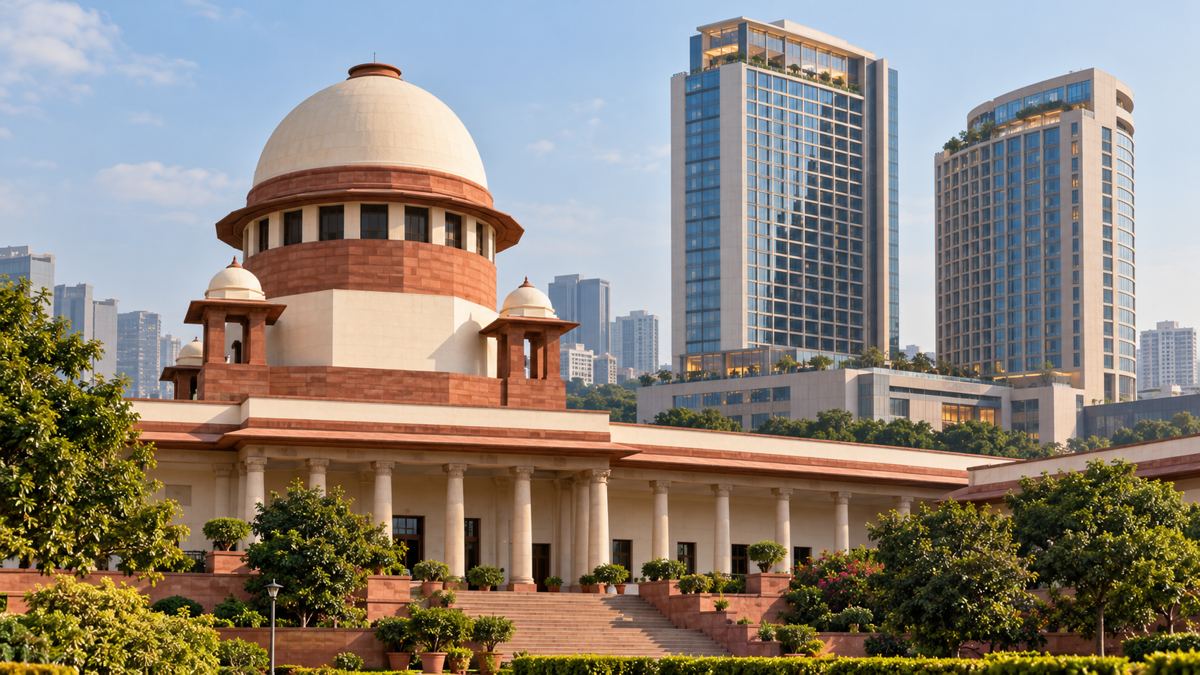
The Supreme Court has upheld the initiation of corporate insolvency resolution proceedings against Gstaad Hotels Private Limited and Neo Capricorn Plaza Private Limited, the companies operating the JW Marriott hotel in Bengaluru and Crowne Plaza hotel in Pune, respectively.
The judgment was delivered on 15 October 2026 and reported by The Economic Times on 21 October. A bench comprising Justices Dipankar Datta and Augustine George Masih dismissed appeals challenging National Company Law Tribunal orders admitting insolvency petitions filed by Omkara Asset Reconstruction Company.
The decision concerns the validity of admitting the companies into insolvency. It should not be described as the Supreme Court itself approving Shree Naman Developers’ acquisition. The Mumbai NCLT separately approved resolution plans totalling ₹1,800 crore, after which ET reported that the plans were implemented and the hotel properties acquired.
What the Supreme Court decided
The official judgment explains that admission under Section 7 of the Insolvency and Bankruptcy Code requires a summary examination of whether a financial debt and default exist. It does not require the tribunal to conduct a detailed trial or reconcile every disputed accounting entry before beginning the resolution process.
The court distinguished the occurrence of default—an event that happens when a debt becomes due and is not paid—from the exact amount outstanding, which can change through interest, charges, adjustments and repayments. A dispute about quantum therefore does not negate an otherwise documented default above the statutory threshold.
The companies had relied on cash-management arrangements, debt-service reserve accounts, disputed interest calculations and their positive operating performance. The court rejected the proposition that profitability prevents insolvency admission when debt servicing has failed.
This does not mean every creditor claim is automatically correct. The resolution professional must verify claims during the insolvency process. The ruling addresses the threshold for admission, not the final adjudication of every rupee claimed.
Loans, assignment and the hotel assets
The dispute arose from loan facilities of ₹600 crore extended by Piramal Finance in December 2017 to the two hotel companies as co-borrowers, alongside separate facilities under the Emergency Credit Line Guarantee Scheme. The financial facilities were assigned to Omkara in December 2022.
After defaults were recorded with the information utility National E-Governance Services Limited, Omkara recalled the facilities in February 2023 and initiated proceedings. NCLT admitted the petitions in July 2025, and the National Company Law Appellate Tribunal affirmed the orders in August 2025.
The Supreme Court’s 50-page judgment upheld that admission path. ET reported admitted liabilities of approximately ₹1,227 crore across the companies.
How the ₹1,800 crore resolution plans fit in
In a later stage of the insolvency process, the Mumbai NCLT approved Shree Naman Developers’ resolution plans valued at ₹1,611 crore for Gstaad Hotels and ₹189 crore for Neo Capricorn Plaza. Together, the plans amount to ₹1,800 crore, exceeding the admitted liabilities reported by ET.
That plan value is the approved resolution consideration, not the market valuation of the hotel brands, a new hotel-construction investment or a price established by the Supreme Court. Brand and management arrangements may also be legally distinct from ownership of the operating companies and underlying assets.
ET said the developer implemented the plans within the stipulated 30-day period and acquired the properties. BrickBharat has not independently reviewed completion filings, land records or any hotel-management agreements, so operational or branding changes should not be inferred.
Implications for lenders and hospitality investors
For lenders, the judgment reinforces that a borrower cannot block admission merely by disputing the final reconciliation if documentary evidence establishes financial debt and default. For borrowers, it underlines the importance of contesting assignments, default records and facility terms at the appropriate stage rather than relying only on operational profitability.
For hospitality-property investors, the case demonstrates how valuable operating hotels can change control through the IBC without a conventional open-market property sale. The headline resolution value should still be assessed alongside liabilities, required capital expenditure, management contracts and future operating performance.
The ruling is significant beyond these two assets because it clarifies the admission standard under Section 7. Its immediate property consequence, however, remains specific: insolvency proceedings against the hotel-owning companies were upheld, while Shree Naman’s acquisition flowed through separately approved and implemented resolution plans.
Sources
- Supreme Court of India — Gstaad Hotels and connected appeal judgment, delivered 15 October 2026.
- The Economic Times — Supreme Court upholds insolvency proceedings involving Bengaluru and Pune hotels, updated 21 October 2026 at 10:35 PM IST.
- The Economic Times — NCLT approves Shree Naman’s ₹1,800 crore resolution plans, published September 2026; used for resolution-plan context.
- Financial Express — “Profitable companies can face insolvency over debt default: SC”, published 22 October 2026.