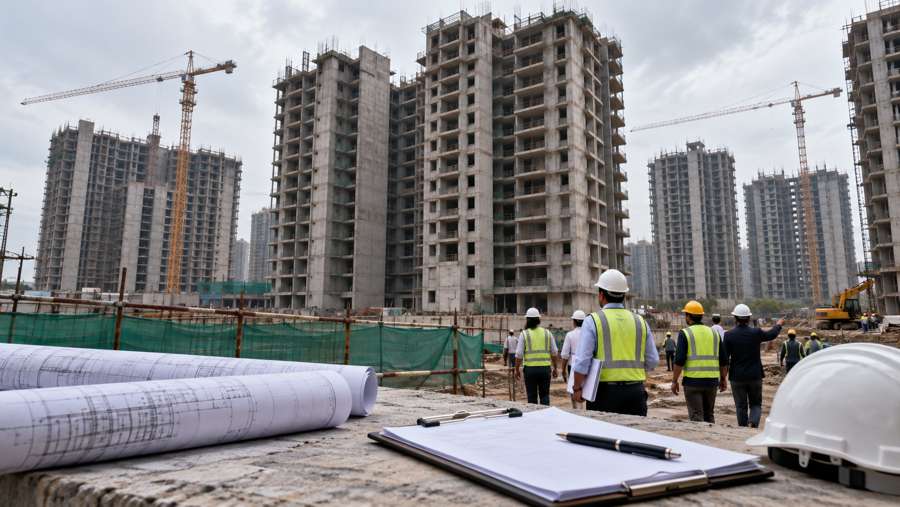
The Supreme Court has considered appointing an independent receiver to oversee completion of 16 stalled Supertech housing projects after questioning progress under the present arrangement, according to reports of its 27 October hearing. The Court invited stakeholders to submit proposals before the next hearing on 16 November. The discussion is a possible change in oversight, not a final order replacing the existing committee or NBCC. [1][2]
For Supertech homebuyers, the distinction is central. A receiver could provide a single court-supervised point of control, but the proposal does not by itself restart construction, set possession dates or identify the money needed for each project.
What changed at the 27 October hearing
Fresh reporting says the bench explored a structure resembling the court-supervised mechanisms used in other large stalled-housing matters. It asked for proposals and possible names for a receiver. NBCC told the Court that one tender had been issued and others were being processed, while construction was expected to begin in 2027. These remain submissions and reported expectations, not completed tender awards across all 16 projects. [1][2]
The current arrangement includes an Apex Court Committee and NBCC as project-management consultant. The Court’s discussion raises the possibility that a receiver could supervise the programme, while the identity and role of the project-management agency would be determined separately. That is why the hearing should not be simplified into a claim that NBCC has already been removed.
How the official case history frames the scale
A Supreme Court order dated 5 February 2026 recorded that the 16 subject projects had approximately 40,000 residential units according to one figure placed before the Court, while counsel for homebuyers put the number above 51,000. The order did not resolve that numerical difference. [3]
That earlier order also documented the search for a mechanism to complete the developments. It is useful background for understanding why the latest hearing concerns governance and finance rather than a newly discovered problem. Today’s development is the Court’s consideration of a different oversight model after the intervening process failed to produce the progress expected by stakeholders.
What the proposal means for homebuyers
A receiver normally acts under the Court’s authority and within directions set by the bench. If appointed, the receiver’s actual powers would depend on the order: control over project accounts, tender supervision, asset sales or reporting cannot be assumed until specified.
BrickBharat’s assessment is that homebuyers should watch for project-level information rather than treating a new supervisory title as the solution by itself. The useful documents would identify available funds, pending approvals, contractors, work packages and realistic completion sequences for each development.
The Court reportedly emphasised that buyers should not face an additional financial burden and referred to unsold inventory and vacant land as possible funding sources. Those ideas still require an executable financial plan. The value, title and saleability of assets can differ, and a funding source is not equivalent to cash already available for construction. [1]
Questions the next hearing needs to answer
The 16 November hearing may clarify whether the Court will retain the committee, appoint a receiver or adopt another arrangement. It may also show which financing and construction proposals are considered credible.
Homebuyers should look for an order rather than relying only on oral observations reported from the hearing. They should also separate programme-wide statements from the status of their own tower or unit. A tender for one project does not establish that work has begun elsewhere.
The immediate development is therefore significant but incomplete. The Court has put the effectiveness of the current Supertech completion structure under scrutiny and opened the door to a receiver-led model. The next durable milestone will be a written order and a project-wise execution plan that can be measured against actual work on site.
Sources
1. Hindustan Times — SC proposes receiver for 16 Supertech projects — published 28 October 2026, 07:38:40 IST; report of the 27 October hearing. 2. Dainik Jagran — Supreme Court hearing on delayed Supertech projects — published 28 October 2026, 07:55 IST; Hindi hearing report. 3. Supreme Court of India — order dated 5 February 2026 — official case-history source. The PDF timed out during direct retrieval in this run; indexed text was available and is used only for earlier procedural context and the disputed unit-count range. A current written order for the 27 October hearing was not located.