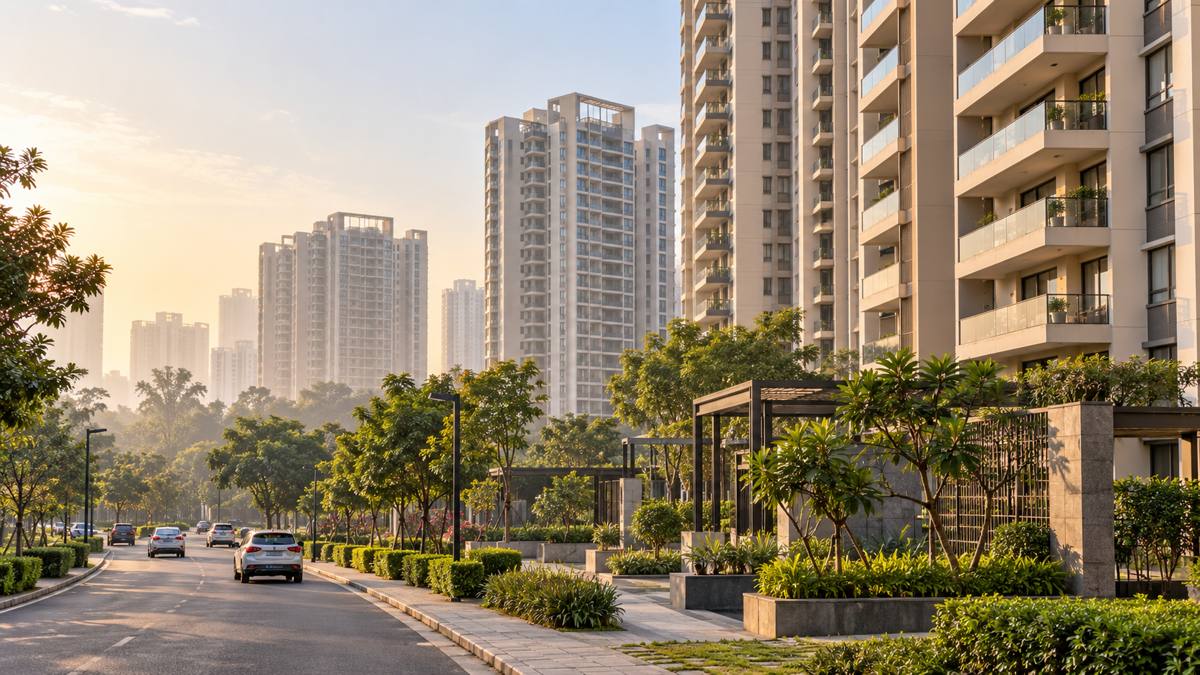
India’s residential property market could record a 10–12% increase in sales during the 2026 festive season, according to expectations reported by *Financial Express* from developers and property consultants. The forecast is being supported by healthy bookings around Ganesh Chaturthi and Onam and continuing demand for larger, premium homes.
The estimate is an industry outlook, not a completed sales result. Niranjan Hiranandani, chairman and managing director of Hiranandani Communities, projected 10–12% festive-season growth, while Anarock vice-chairman Santhosh Kumar expected growth of about 10%. The publication reported that residential developers typically book at least one-third of annual sales during the festive period. The article was first uploaded on 12 October and updated on 13 October 2026. Financial Express
Premium housing is carrying the festive demand story
The current demand is not evenly spread across price bands. Developers cited by *Financial Express* described strong interest in apartments priced from roughly ₹2 crore to ₹5 crore, with buyers seeking larger homes, better layouts, useful amenities and stronger long-term value.
That assessment is consistent with the wider shift recorded during 2026. Knight Frank India data reported by *Hindustan Times* showed that homes priced above ₹1 crore represented 56% of sales across eight major cities during January–September 2026, compared with 16% in 2018. The same dataset placed total sales at about 2.6 lakh units for the nine-month period—broadly stable rather than rapidly expanding. Hindustan Times
CareEdge Ratings separately identified a structural movement towards premium and luxury housing, as the share of homes below ₹1.5 crore in new launches fell from 85% in the first quarter of 2022 to 47% in the first quarter of 2026. This does not mean demand has disappeared below ₹1.5 crore; it shows that developers’ new-supply mix has moved sharply towards higher ticket sizes. Business Standard
Why the 10–12% forecast needs context
Market estimates vary because consultancies cover different cities, project sets and periods. Anarock reported a 3% year-on-year increase in sales across seven major cities during July–September 2026, to approximately 1,00,220 homes. However, separate PropEquity data cited by *The Times of India* indicated a 6% decline for the quarter. These figures should not be combined without accounting for their different samples and methods. The Times of India
Supply is another reason for caution. Knight Frank’s nine-month assessment said launches exceeded sales in the third quarter for the sixteenth consecutive quarter. More launches can expand buyer choice, but persistent additions above absorption can also increase inventory in particular cities or micro-markets.
The festive forecast therefore describes a possible seasonal improvement from current conditions. It does not establish that every city, project or price segment will grow by the same rate, or that full-year volumes will rise by 10–12%.
Construction and land costs are squeezing affordability
Anarock Research found that the average construction cost for a standard-plus residential project rose from ₹2,681 per sq ft in 2021 to ₹3,604 per sq ft in 2025, an increase of 34%. Average housing prices across the top seven cities increased faster—by 59% over the same period—indicating that land values, location premiums and market positioning also played major roles. Business Standard
The same assessment estimated a further 8–10% pressure on construction costs during 2026 from steel, fuel-linked logistics, imported finishes and mechanical, electrical and plumbing inputs. That estimate differs from JLL’s earlier projection of a 3–5% increase across asset classes in 2026, illustrating how assumptions and the timing of cost shocks can produce different forecasts.
For developers, premium projects may provide more room to absorb higher land and construction costs. For middle-income buyers, however, the combination of higher prices and fewer affordable launches can make festive discounts less meaningful if the base price, unit size or financing cost has already increased.
What homebuyers should verify before booking
A festive offer should be assessed against the property’s complete cost, not the advertised discount alone. Buyers should compare the agreement value, floor and location charges, parking, maintenance deposits, taxes and financing terms with recent prices in the same project and nearby registered transactions where accessible.
Project status remains more important than seasonal urgency. Buyers should verify the applicable state RERA registration, sanctioned plans, possession schedule, construction progress and any changes disclosed by the promoter. A limited-period waiver should not substitute for checking title, approvals and delivery history.
BrickBharat’s assessment is that a strong festive season would confirm resilience in premium housing, but broad market health requires more than higher ticket values. Sales volumes, affordable and mid-income supply, city-level inventory and actual project execution will show whether the improvement reaches a wider group of homebuyers.
Milestones to watch after Diwali
The most useful confirmation will come from listed developers’ quarterly operational updates and independent market reports published after the festive period. Readers should compare booking value with units sold, cancellations, collections and new launches. Higher sales value can result from price increases or larger homes even when transaction volumes are unchanged.
Sources and verification
- Financial Express — “Premium lights up housing as buyers trade up”. First uploaded 12 October 2026, 7:02 PM IST; updated 13 October 2026, 3:48 PM IST.
- Hindustan Times — Housing sales hold steady at 2.6 lakh in January–September 2026. Published in the week preceding 13 October 2026; exact displayed publication time was not available in the retrieved extract.
- The Times of India — Q3 2026 city housing-sales comparison. Published 28 September 2026.
- Business Standard — Construction costs rise 34%, housing prices 59% in five years. Published 3 September 2026.
- Business Standard — Premium supply rises as sub-₹1.5 crore launch share falls. Published 26 August 2026.
Verification limitation: The central festive-sales figure is a forward-looking industry estimate reported by *Financial Express*, not an audited result. Market datasets cited here use different city coverage and methodologies; their figures are presented separately.